
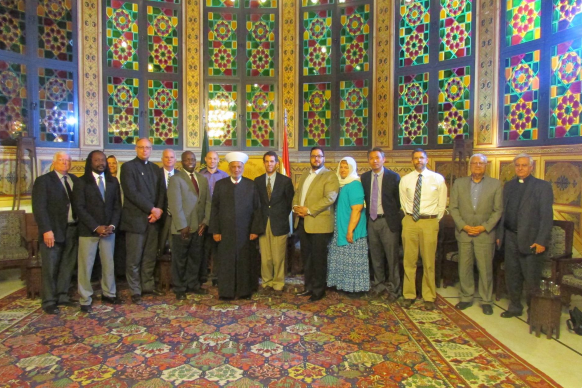
Interfaith relationships
Rooted in Christian faith. Open to our neighbors. Committed to a shared world.
Our calling to Christian unity draws us into relationships with the wider world. As Rev. Paul S. Tché explains in Interreligious Commitment as an Ecumenical Call, churches pursue reconciliation so that they may engage their neighbors together. Interfaith dialogue expresses that calling through trust, mutual understanding, and shared responsibility for a just and peaceful world.
Christian unity and interfaith engagement have distinct starting points. Christians seek communion in Christ; with neighbors of other faiths, we seek understanding and a shared life that respects their distinctive beliefs and gifts.
An ecumenical calling for the world
Tché’s paper understands ecumenism as a commitment to authentic relationships: among churches, with God, and with the world. That commitment asks Christians to listen with humility, acknowledge their own limitations, and encounter religious neighbors on their own terms. Shared challenges call us to bring our faith into conversation and action with others.
Why we work through the National Council of Churches
Disciples participate in interfaith dialogue alongside other Christian communions through the National Council of Churches (NCC). The Interreligious Relations Convening Table provides a shared setting for theological reflection, relationship building, and common counsel with neighbors of other faiths.
Participating together helps churches learn from one another while developing lasting relationships across religious communities. The NCC’s peace statement encourages churches to undertake interreligious work ecumenically wherever possible, connecting dialogue with solidarity and practical peacebuilding.
The NCC’s national dialogues include relationships with:
- Jewish communities
- Muslim communities
- Buddhist communities
- Hindu communities
- Sikh communities
Through these relationships, participants explore theological questions, deepen understanding, and consider common responses to concerns affecting their communities and the wider world.
Relationships that serve peace
The NCC connects interreligious relationships with active peacebuilding. Its policy calls Christians to know and love their neighbors, confront religious prejudice, and develop common work for peace through dialogue, education, advocacy, and solidarity.
This commitment also includes addressing religious nationalism when religious identity is used to exclude others or deny their dignity and rights. The NCC invites Christian and interfaith partners to examine these harms together and work toward communities in which all can belong.
NCC policy · 2019
Interreligious Relations with a Focus on Peace
A call for churches to deepen relationships across faiths and pursue peace together through mutual learning, joint advocacy, and solidarity.
NCC policy · 2024
The Problem of Religious Nationalism, in the US and Globally
A statement opposing harmful combinations of religious identity and nationalism, and inviting collaboration to protect human dignity and religious freedom.
CUIM resources for learning and reflection
Theological foundation · Paul S. Tché · 2022
Interreligious Commitment as an Ecumenical Call
An exploration of how Christian unity and interreligious relationships inform the church’s calling in a religiously diverse world.
Study guide · Edited by Clark M. Williamson
The Church and the Jewish People
A Disciples study guide exploring Scripture, Jewish history, Christian theology, and practical steps toward more responsible Jewish–Christian relationships.
Commission on Theology · Received by the General Assembly, 1993
A Statement on Relations Between Jews and Christians
A theological statement confronting Christian anti-Judaism, affirming God’s continuing covenant with the Jewish people, and calling the church to renewed understanding and relationships.
Bring the conversation into your congregation